
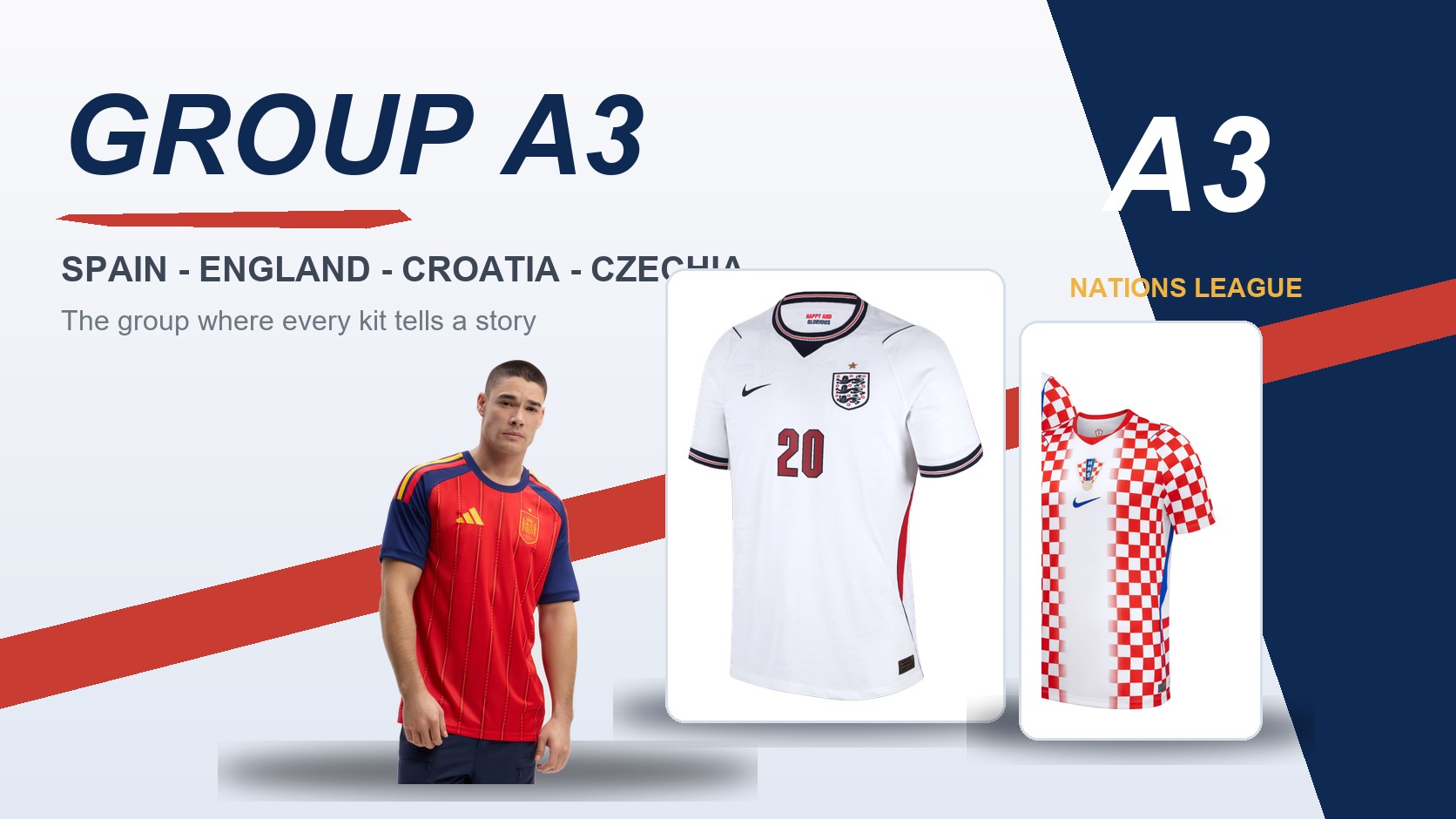
Group A3 of the 2026/27 Nations League is the group where shirt interest and football interest point in exactly the same direction. Spain, England, Croatia and Czechia share six matchdays between 26 September and 15 November 2026, and every one of those fixtures is a reason to look at a particular shirt. This deep dive compares the four sides team by team, covering the colours, the group mathematics and the qualification picture, so you can decide which Group A3 kit to buy before the November window closes. Two of the four began the campaign as expected favourites, and the group is now effectively decided by whether Czechia can take points off the pair that have already beaten each other.
Key takeaways
- Group A3 contains Spain, England, Croatia and Czechia, with six matchdays running from 26 September to 15 November 2026.
- The group has two routes into the March 2027 quarter-finals, and both routes currently run through Spain and England.
- Czechia are the swing side: they play both favourites at home twice, so their results reshape the whole table rather than just their own row.
- The three Group A3 shirts that generate the most demand are the Spain home shirt in red, the England home shirt in white and the Croatia checkerboard.
- Only three matchdays remain after 6 October, and all three are European evening kick-offs in Central European Time.
- Spain host England on the final matchday, so the last fixture of the group can decide first place as well as qualification.
Everything below uses European local time, which means Central European Summer Time through 25 October 2026 and Central European Time from 26 October onward. If you are planning around a kick-off, that switch is the detail worth checking first.
How Group A3 is shaped: four teams, three matchdays left
The 2026/27 Nations League league phase puts sixteen teams into four groups of four, and each group plays six matches before the top two advance to two-legged quarter-finals in March 2027. Group A3 is Spain, England, Croatia and Czechia, and it is the group where the two strongest sides on paper were drawn against each other in the opening round rather than kept apart. England hosted Spain on 26 September, and Czechia hosted Croatia on the same evening, which set up a schedule where the two expected qualifiers meet twice and the two chasing sides meet twice.
The structure matters more than usual this cycle. In a group where the favourites meet early, the head-to-head result between them becomes a tie-breaker, and the chasing two are left fighting over the remaining points. That is why Czechia's four fixtures against Spain and England carry more weight than Croatia's, even though Croatia hold the profile of the stronger of the two chasing sides.
After the opening window closed on 6 October 2026, the group had three matchdays left. England host Croatia on 12 November, Spain host England on 15 November, and the group completed on 17 November. Three matchdays is 18 available points across four teams, which is the smallest remaining sample that can still produce a two-team tie at the top and still be settled by results rather than by goal difference alone.
Spain: red at home, and the pressure that comes with it
Spain are the group most supporters arrive for. The 2026 home shirt is red, the away version is navy, and the pairing is among the most recognisable in world football. In Group A3 Spain play three home fixtures, including the final matchday against England, which means the red shirt is the version that carries the most matchdays of the group.
What makes Spain interesting for a shirt buyer is not the colour but the distribution. Three home fixtures means three occasions where the home shirt is the one worn on the pitch, and the opening-round fixture at England means the navy away version also gets used inside the league phase. A buyer choosing one Spain shirt for the whole Nations League window is choosing between the shirt that gets seen most and the shirt that gets used in the fixture most people want to watch.

The group mathematics give Spain the least complicated path. Having already played England once and having three home fixtures left, the worst case is a set of results that leaves qualification dependent on a dead rubber. The pressure that creates is the opposite of the pressure England face, because Spain can reach the quarter-finals without needing a favourable run against a side they have already beaten.
England: white at home, and a November test that decides the group
England's 2026 home shirt is white, with a light blue goalkeeper shirt alongside it, and the away version is dark navy. The home shirt is the one that gets the most airtime in Group A3: England host Spain on 26 September, host Croatia on 12 November, and play the Spain return on the road on 15 November. Three home fixtures in the group means three occasions where the white shirt is what appears on the pitch.
England's group position is the mirror image of Spain's. They have the same number of home fixtures, but they face the side that beat them in the opening round on the final matchday, and they host the chasing side that has the most to gain from a defeat. If England lose at home on 12 November, the group stops being a two-team race and becomes a three-team one with two places available.

For a supporter, the practical point about the white shirt is wear rather than availability. White shows marks from a supporter's section, and it layers less comfortably under a coat than a darker shirt. Supporters who intend to wear the shirt to matches in November are usually better served by a shirt that stays presentable through a long evening, which is a case for checking the fabric and the finish before ordering rather than after.
Croatia: the checkerboard that travels
Croatia's home shirt is the white checkerboard, and the away version is navy. It is the easiest shirt in Group A3 to identify from a distance, because the pattern does not depend on the colour scheme around it. That visibility is a large part of why the Croatia shirt is the most requested item from this group.
Croatia play two home fixtures in the group, including the 3 October evening match against England at 18:00 CEST, which is the earliest kick-off in Group A3's published schedule. The other side of that coin is the opening-round trip to Czechia, where Croatia wear navy. So the group splits the Croatia range almost evenly between the two colourways.

Where Croatia's route is awkward is the arithmetic. With two places available and two fixtures left at home, the group gives Croatia a path back in only if the top two drop points to Czechia as well. That is not an impossible scenario, but it is a scenario that requires results outside Croatia's own control, and it is why the 3 October home fixture against England carried more weight than a table position alone would suggest.
Czechia: the side that makes the group awkward to call
Czechia are the swing side in Group A3, and the reason is structural rather than historical. They play both Spain and England at home in the opening round, and the same two fixtures return in the closing round of the group stage. Four of Czechia's six matches are therefore against the two teams expected to advance, which means every result they produce lands directly on the two rows that matter.
It also means Czechia's own fixtures are the ones worth watching. A group where the chasing side meets both favourites twice cannot be settled by the matches between the favourites, so the Czechia fixtures carry more information about the final table than any other in Group A3. That is an unusual amount of leverage for a side that is not among the two strongest in the group.
The Czechia shirt is the least discussed of the four, which is its own kind of signal. Supporters tend to arrive late to the sides that sit between the favourites and the outsiders, and a white home shirt with red and blue detail is an easier purchase to justify to a supporter section than a neutral design. The full range sits in the Czech Republic national team collection, and it is worth putting the same amount of thought into it as the other three.
Group A3 match schedule and European-time kick-off slots
Every Group A3 fixture below is listed in European local time with the day of the week, because the zone changes mid-season. The September and early-October rounds fall in Central European Summer Time, and the November rounds fall in Central European Time. A November kick-off listed as 20:45 is one hour earlier in absolute terms than a September kick-off listed as 20:45, which is the single most common planning mistake in this competition.
| Matchday | Date | Kick-off | Zone | Fixture | Home / away |
|---|---|---|---|---|---|
| Matchday 1 | Saturday 26 September 2026 | 20:45 | CEST / UTC+2 | Czechia vs Croatia | Czechia home, Croatia away |
| Matchday 1 | Saturday 26 September 2026 | 20:45 | CEST / UTC+2 | England vs Spain | England home, Spain away |
| Matchday 3 | Saturday 3 October 2026 | 18:00 | CEST / UTC+2 | Croatia vs England | Croatia home, England away |
| Matchday 5 | Thursday 12 November 2026 | 20:45 | CET / UTC+1 | England vs Croatia | England home, Croatia away |
| Matchday 6 | Sunday 15 November 2026 | 20:45 | CET / UTC+1 | Spain vs England | Spain home, England away |
The 3 October fixture is the only Group A3 match that does not kick off at 20:45. It starts at 18:00 CEST, which makes it an early evening match in Central Europe and a different kind of evening further west. Everything left in the group after that date is a 20:45 CET evening kick-off, all in November.
How the top two places get decided
Two teams from each League A group reach the quarter-finals, and the group stage supplies only fixtures. There is no play-off inside the group and no separate tie-breaker round, so the ranking that matters is the one produced by six matches. That is why the head-to-head result between Spain and England carries real weight: it is the tie-breaker that applies if the two finish on the same number of points, and it was settled in the opening round.
What the remaining schedule does is force decisions. Spain host England on the final matchday, and England host Croatia one matchday earlier. If England beat Croatia at home on 12 November, England control their own destiny going into the Spain fixture. If they do not, the Spain match becomes a qualifier rather than a formality, and Spain face the same pressure in reverse.
Czechia sit on the other side of that calculation. Their remaining fixtures decide how much distance opens up behind the top two, and a group where the third-placed side has already banked points against both leaders is a group where the final table can look very different from the one the opening round suggested.
| Team | Home shirt | Away shirt | Home fixtures in the group |
|---|---|---|---|
| Spain | Red | Navy | Three, including the final matchday against England |
| England | White | Dark navy | Three, including 12 November against Croatia |
| Croatia | White checkerboard | Navy | Two, including the opener at Czechia and 3 October at home |
| Czechia | White with red and blue detail | Red | Three, including two against the two favourites |
Read across the home-fixture column and the pattern is clear. Spain, England and Czechia each play three matches in front of their own supporters, while Croatia play two. For a shirt buyer that column is more useful than any ranking, because it tells you how often each colourway will actually be worn inside the group.
What the four Group A3 shirts have in common
Three of the four teams in Group A3 play in a shade of red or white, which is unusual for a group being sold on colour variety. Spain are red at home and navy away. England are white at home and dark navy away. Croatia are a white checkerboard at home and navy away. Czechia are white with red and blue detail at home and red away.
The practical consequence for a collection is that the navy away shirt is the shared item. Three of the four teams use it, and the fourth uses red. If you are building a Group A3 set on a budget, the away shirts are where the value sits, because you can cover more than one team with the same colourway and the same fit.
The other shared feature is timing. All four teams are on the same two-season home cycle, so the home shirts are not rotating mid-competition and there is no third-shirt variation inside the league phase. That means a Group A3 shirt bought this autumn is a current-cycle shirt, and the version that arrives at your door is the version that gets worn in November.
If you are completing a broader national team set rather than focusing on this group, the same-cycle logic applies across the whole competition, and the Spain, England and Croatia ranges all sit within the current window.
Which Group A3 shirt to start with
Start with the shirt your team actually supports, because the three remaining matchdays are the cheapest window of the whole competition for a Group A3 buyer. Any shirt bought now is used three times before 17 November 2026, which is the best return on a single purchase available in this competition.
If you are buying for someone else and have no team to anchor on, the England home shirt is the easiest recommendation to justify. White is a neutral colour, the shirt is worn three times at home, and the November fixtures are evening kick-offs, which suits a matchday purchase better than a shirt that will only be seen once.
If you are building across the group rather than within one team, the Czechia shirt is the value option. It is the least requested item in Group A3, it is a straightforward white home design, and the team's fixture list gives it more visibility than a mid-table side normally gets. It is also the easiest shirt in the group to buy without a strong reason, which is exactly why it is worth the shelf space.
Whatever you choose, check the size against a shirt you already own rather than against a size chart. National team shirts from different suppliers cut differently, and the difference between a fan cut and a player cut is larger than the difference between two brands.
Frequently asked questions
Which Group A3 side has the easiest route to the quarter-finals?
Which Group A3 side has the easiest route to the quarter-finals?Why is Czechia the side that makes Group A3 awkward to call?
Why is Czechia the side that makes Group A3 awkward to call?What is the Nations League record for the Croatia checkerboard?
What is the Nations League record for the Croatia checkerboard?How do the Spain and England home shirts differ away from each other?
How do the Spain and England home shirts differ away from each other?When do Spain and England meet again in the 2026/27 Nations League?
When do Spain and England meet again in the 2026/27 Nations League?How many Group A3 fixtures are left to buy a shirt around?
How many Group A3 fixtures are left to buy a shirt around?Group A3 completes on 17 November 2026, with the quarter-finals drawn for March 2027. The three remaining Group A3 matchdays are the ones that decide the group's two places, and they are all 20:45 Central European Time evening kick-offs.