
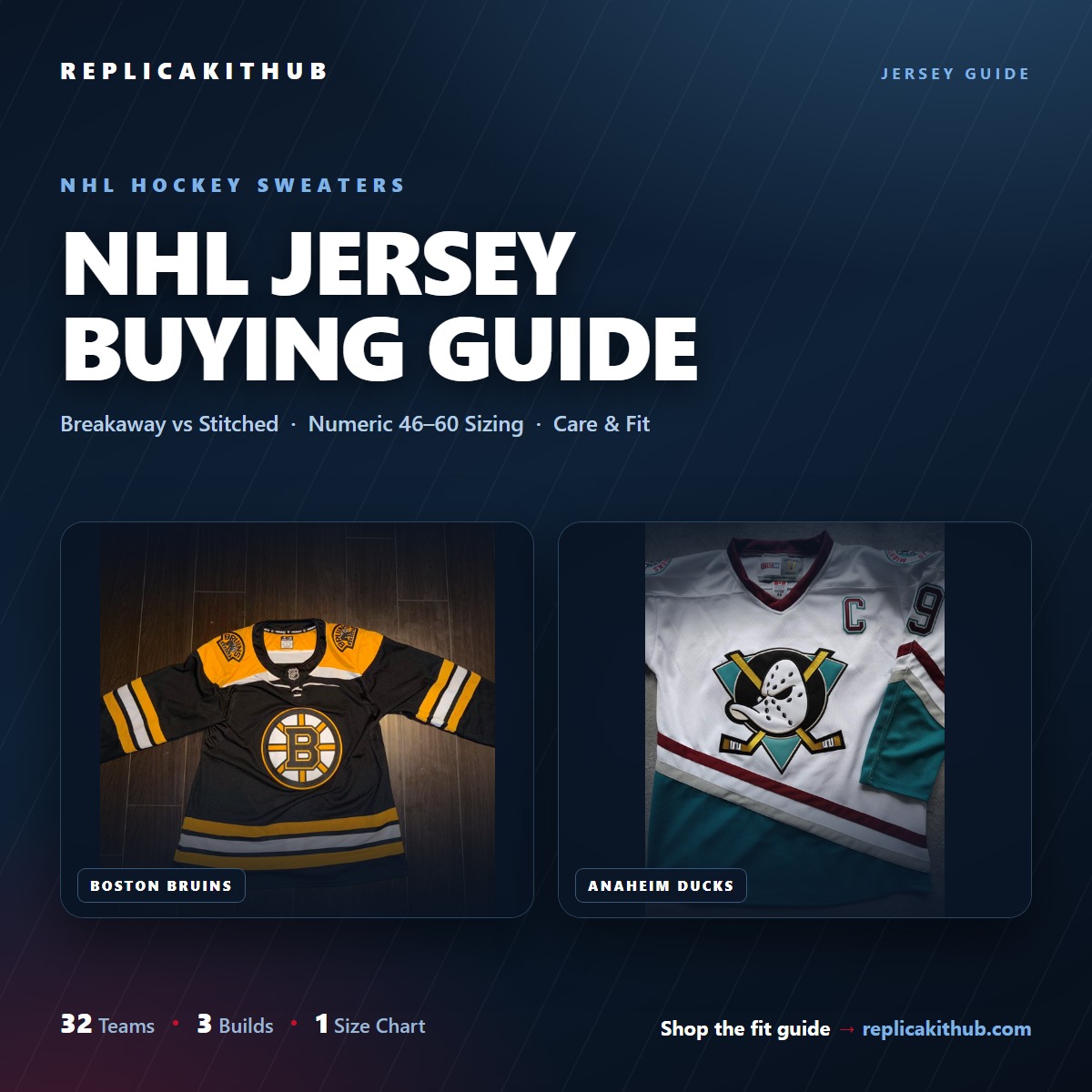
Quick answer
If you want one sweater to wear to games and around town, buy a breakaway in your normal t-shirt size. If you want a heavier garment with layered twill and a longer lifespan, buy a premium stitched build, and size up only if you plan to layer it over a hoodie. Hockey sweaters are the most generously cut garment in any of our leagues, so most people do not need to size up. The rest of this guide covers crest construction, the numeric tag system, colourways and care.
What “breakaway” and “premium stitched” actually mean
Both names describe how the crest and numbers are made and how heavy the fabric feels, not how good they look on a screen. A breakaway is the lightweight fan sweater: a single layer of fabric with a printed or lightly pressed crest. It exists because arena seating is warm. You wear a sweater for three periods plus intermissions, often indoors, often over a hoodie, and a heavy garment gets uncomfortable fast.
A premium stitched build is the opposite trade-off. The crest is a separate piece of twill sewn onto the front panel, and the numbers and nameplate are layered so light catches the edges. That construction adds weight, which is why a stitched sweater sits closer to the body than a breakaway of the same tag size and why it holds its shape over repeated wears. If you have ever wondered why a sweater feels different from a basketball jersey in the same nominal size, this is the reason: the crest is structural, not printed.
Breakaway vs premium stitched: side by side
| What you are comparing | Breakaway | Premium stitched |
|---|---|---|
| Crest | Printed or lightly pressed single layer | Separate twill crest, sewn on |
| Numbers and nameplate | Printed | Layered tackle twill, stitched |
| Fabric weight | Lightest in the range | Noticeably heavier |
| Drape | Looser, more forgiving | Closer fit, holds its shape |
| Best for | Arena seating, warm rooms, everyday wear | Collectors, cold rinks, long seasons |
| Washing | Machine wash cold, inside out | Machine wash cold, inside out, dry flat |
Neither column is “better”. The honest way to choose is to work backwards from where you will wear it: the more time it spends indoors, the more reason to take the lighter build.
Which build should you buy?
You want one sweater for game night
Take the breakaway. It is the build that disappears on you during a three-period game, and it survives being worn under a jacket on the way home. If you own a single hockey sweater, this is the one that earns its place.
You want the shirts that feel like the ones on the ice
Take the premium stitched build. The stitched crest is the visual difference people actually notice at arm’s length, and the layered numbers are what make the sweater photograph well. It also lasts longer, which matters if you are buying for a favourite player rather than for a specific season.
You are buying for a child
Youth hockey sweaters are cut as Youth S/M and similar grouped tags rather than the adult numeric system, because children move through sizes faster than a numeric scale can track. Check the youth table on the size guide before ordering — the age range is more reliable than the tag letter.
NHL sweater sizing: why the numbers look strange
Adult hockey sweaters are tagged with even numbers instead of S/M/L. That is a heritage of the garment: a numeric tag is a chest measurement in inches at the loose fit the sweater was designed for, and the letters are just a translation. The table below is the actual chart we work to.
| Numeric tag | Alpha | Chest circumference | Sleeve length | Back body length |
|---|---|---|---|---|
| 46 | Small | 44 – 46" (112 – 117 cm) | 32.5" (83 cm) | 30.5" (77 cm) |
| 50 | Medium | 48 – 50" (122 – 127 cm) | 33.5" (85 cm) | 31.5" (80 cm) |
| 52 | Large | 51 – 53" (130 – 135 cm) | 34.5" (88 cm) | 32.5" (83 cm) |
| 54 | X-Large | 54 – 56" (137 – 142 cm) | 35.5" (90 cm) | 33.5" (85 cm) |
| 56 | 2X-Large | 57 – 59" (145 – 150 cm) | 36.5" (93 cm) | 34.5" (88 cm) |
| 60 | 3X-Large | 60 – 62" (152 – 157 cm) | 37.5" (95 cm) | 35.5" (90 cm) |
Two things follow from that table. First, a size 50 sweater has a 48–50 inch chest, which is roughly a medium in most other garments — but the sleeve and body lengths are long by design, because the cut assumes layers underneath. Second, the jump between tags is two inches, so if you are between two numeric tags you are genuinely between two sizes rather than at the edge of one.
Measure a sweater you already like, pit to pit, and compare it with the chest circumference column rather than with the tag letter. That single step avoids almost every exchange.
Home, away, alternate and Winter Classic colourways
Colourway is the second decision after size, and it is the one people regret most often. Home and away colourways stay in production and stay recognisable for years. Alternate and special-event colourways are the ones that look sharpest in a photo and also the ones that age fastest once the event passes.
A practical rule: buy home or away for the sweater you will wear weekly, and buy the event colourway only for a player you already follow. That keeps your rotation wearable and your one-off purchase meaningful.
All 32 clubs sit in one filterable collection, so you can compare colourways without hunting across pages: browse all NHL jerseys.
Custom names and numbers: what to expect
Custom builds let you put any name and number on a blank sweater. Two expectations are worth setting before you order. First, custom sweaters are made to order, so they sit outside the fastest part of the range — plan around that if you are buying for a specific date. Second, a custom build locks in the size you choose; because it cannot be returned as easily as a stock sweater, get the numeric tag right first using the table above.
If you are choosing a nameplate, remember that long surnames shrink the printed letter height to fit the plate. That is normal and it is how the on-ice product works, but it is worth knowing before you compare a custom sweater with a stock one.
Caring for a hockey sweater
Turn it inside out before it goes in the machine. Cold water, gentle cycle, and keep it away from anything with zips or velcro, which is the fastest way to pill a knit shoulder. Do not tumble dry a sweater — heat is what makes a stitched crest start to lift at the corners. Dry it flat, reshaping the body while it is still damp.
For stitched builds, dry flat rather than hanging. A wet sweater on a hanger carries its own weight through the shoulder seams, and that is where the shape goes first.
Store sweaters folded rather than hung as well. A knit shoulder that spends months on a hanger takes a set, and the crease shows the first time you wear it again. Fold flat with the crest facing upward so nothing presses into the front panel, and keep a stitched sweater out of a vacuum bag — compressing a sewn crest for a season is how corners start to lift.
Youth sizing: grouped tags, not a numeric scale
Youth hockey sweaters skip the adult numeric system entirely and use two grouped tags, each covering a four-year span. That is more useful than a single age label, because two children of the same age can differ by several inches of chest circumference.
| Size tag | Age range | Chest circumference | Back length |
|---|---|---|---|
| Youth S/M | 8 – 11 years | 36 – 38" (91 – 96 cm) | 25.5" (65 cm) |
| Youth L/XL | 12 – 15 years | 40 – 42" (102 – 107 cm) | 27.5" (70 cm) |
The detail worth noticing is that Youth L/XL reaches a 40–42 inch chest, which overlaps the bottom of the adult range. A teenager sitting near that boundary is usually happier in an adult size 46, because the adult sweater is longer in both the sleeve and the body — and a sweater that rides up at the wrist is the complaint that follows grouped youth tags. If your child is between the two, buy the youth tag for this season and expect to move to an adult 46 the next.
Frequently Asked Questions
Do NHL sweaters run big?
Yes, they are the most generously cut garment we sell. The cut is designed to layer over a hoodie, so many buyers take their normal shirt size rather than sizing up. Compare the chest circumference on the size chart with a sweater you already own.
What is a breakaway jersey?
Breakaway is the lightweight fan sweater. It uses a lighter fabric with a printed or lightly pressed crest, which keeps it comfortable through a full game in arena seating and easier to wear casually.
Is a premium stitched sweater worth the difference?
If you want a heavier crest, layered numbers and a longer lifespan, yes. The stitched build is noticeably thicker, sits closer to the body than a breakaway in the same tag, and holds its shape better over repeated wears.
How do I convert a numeric tag to a letter size?
On the adult hockey chart, 46 is Small, 50 is Medium, 52 is Large, 54 is X-Large, 56 is 2X-Large and 60 is 3X-Large. Because each step is two inches of chest circumference, being between two tags means you are genuinely between two sizes.
Are Winter Classic and event colourways available all year?
Special-event colourways sit in the same collection as the home and away sweaters, so you can filter by club and see current and vintage designs together. Availability varies by club and by size, which is normal for event designs.
Can I wear a hockey sweater over a hoodie?
Yes, and that is what the cut is designed for. Because the tag sizes step in two-inch increments, you can take your normal size for layering without the sweater looking oversized. If you want a closer fit, go down one numeric tag instead.
Where to start
If you already know your numeric tag, go straight to all NHL jerseys and filter by club and colourway. If you are still deciding, read the hockey size chart first, then compare builds inside the NHL fan gear hub. The breakaway is the right first sweater for most people; the stitched build is the right second one.