
Quick answer
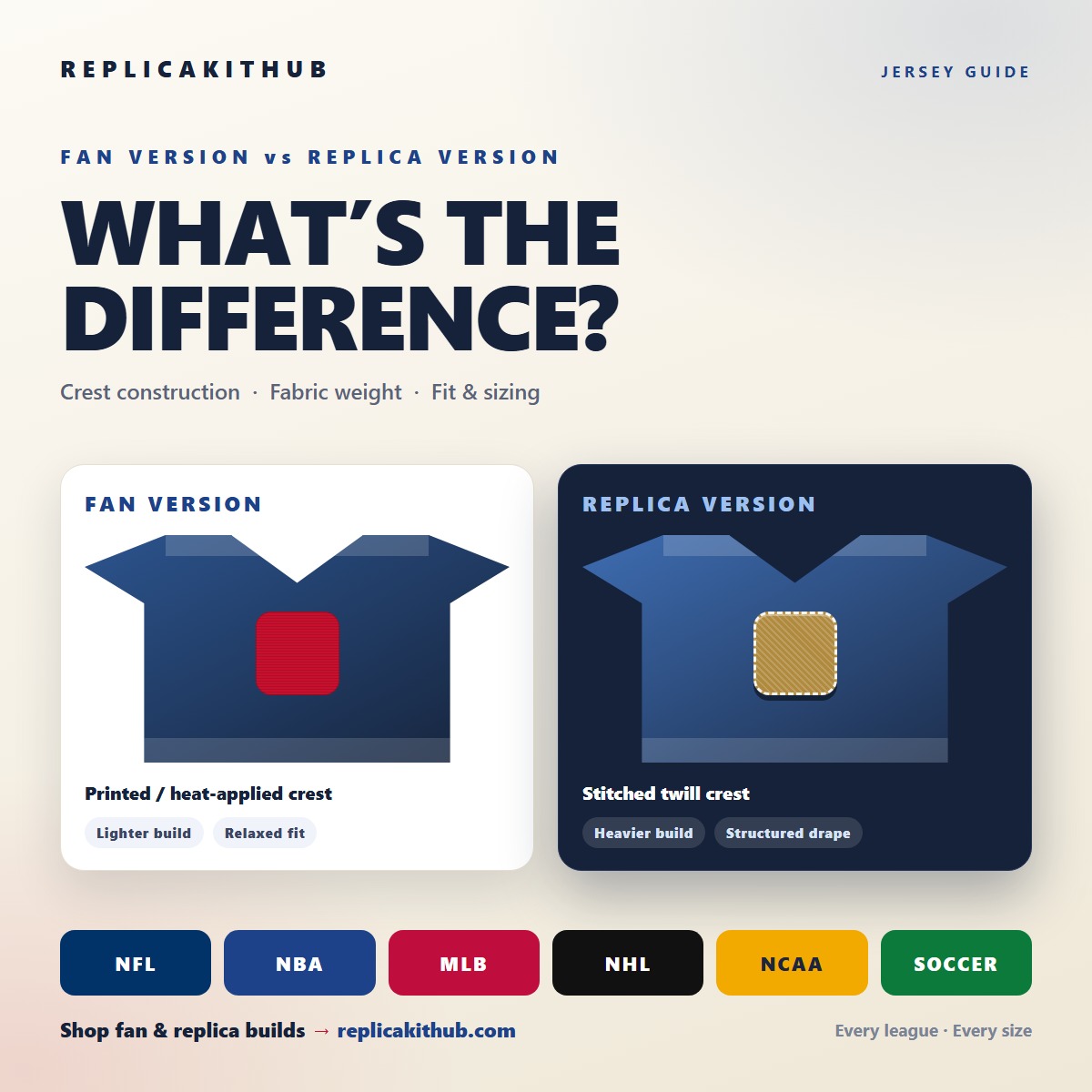
A fan version is the lighter, lower-cost build with a printed or lightly pressed crest. A replica version is the heavier build with a stitched crest and layered numbers. Fan versions are the better everyday buy for most people; replica versions are the better long-term buy if you want the crest to be a physical part of the shirt rather than an image on it. In every league we stock, both builds share the same size chart, so switching between them does not change your size.
The one-paragraph answer
The distinction is about construction, not about quality tiers. Both builds are made to the same size charts and are designed for the same sport. What changes is how the team marks are attached and how much the garment weighs. Printed marks are lighter, cheaper to produce and easier to wash. Stitched marks add weight and structure, look sharper at arm’s length, and hold their shape across more seasons. Choose the printed build if you want a shirt you can wear anywhere; choose the stitched build if the shirt is going to be a keeper.
Fan version vs replica version at a glance
| What changes | Fan version | Replica version |
|---|---|---|
| Crest and team marks | Printed or lightly pressed | Separate twill, sewn to the panel |
| Numbers and nameplate | Printed | Layered, stitched |
| Weight | Lighter | Heavier |
| Drape | Looser | Closer to the body |
| Washing | Very forgiving | Needs inside-out, cold, dry flat |
| Lifespan | Good for a few seasons | Holds shape across many seasons |
| Best for | Everyday wear, warm rooms, first jersey | Collecting, cold venues, gifting |
The weight row is the one people underestimate. On a warm day, a printed shirt is the difference between wearing it all afternoon and taking it off after an hour.
How each build is made
Printed builds
The team marks are applied directly to the fabric. There is no second layer, so the chest stays flat against you and nothing lifts at the corners over time. This is also why printed builds are the most comfortable option in a warm arena or a summer match: the garment behaves like a normal shirt rather than like a panel with something attached to it.
Stitched builds
The crest is cut as a separate piece of twill and sewn onto the front panel, and the numbers and nameplate are layered so that a shadow line catches the light at the edges. That construction adds stiffness, which is exactly why a stitched shirt sits closer to the body than a printed one in the same size — the crest does not stretch with the fabric. It is a deliberate trade of comfort for presence.
Which one matches how you will actually wear it
You wear it to games and out afterwards
Printed. You want the lightest version of the shirt, because you are keeping it on for hours and moving between indoors and outdoors.
You want one shirt per team, framed or hung
Stitched. If the shirt is going on a wall or a rail more than on your back, the heavier crest is the whole point, and the construction tolerates being handled.
You are buying a gift
Stitched, in the recipient’s normal size. A heavier build reads as the more substantial gift, and because stitched and printed builds share a size chart, you only need to get the size right once.
You are buying for a growing child
Printed, and check the youth table rather than the adult one. Children move through sizes faster than any build lasts, so the lighter, lower-cost shirt is the sensible choice.
Sizing: fan cut vs replica cut
Here is the part that surprises people: in every league we stock, the fan and replica builds are cut to the same size chart. What changes is how the two builds sit on the same body, because the stitched crest does not stretch. If you are at the top of a size band and buying stitched, go up one tag; if you are at the bottom of a band, stay where you are.
American football
| Alpha | Numeric | Chest circumference | Front length | Suggested weight |
|---|---|---|---|---|
| S | 40 | 38 – 40" | 29.5" | 130 – 155 lbs |
| M | 44 | 41 – 43" | 30.5" | 155 – 180 lbs |
| L | 48 | 44 – 46" | 31.5" | 180 – 205 lbs |
| XL | 52 | 47 – 49" | 32.5" | 205 – 230 lbs |
| 2XL | 56 | 50 – 52" | 33.5" | 230 – 255 lbs |
Basketball
| Alpha | Numeric | Chest circumference | Back length | Suggested height |
|---|---|---|---|---|
| S | 40 | 36 – 38" | 29.0" | 5'5" – 5'8" |
| M | 44 | 39 – 41" | 30.0" | 5'8" – 5'11" |
| L | 48 | 42 – 44" | 31.0" | 5'11" – 6'1" |
| XL | 52 | 45 – 47" | 32.0" | 6'1" – 6'3" |
| 2XL | 56 | 48 – 50" | 33.0" | 6'3" – 6'5" |
Hockey
| Numeric tag | Alpha | Chest circumference | Sleeve length | Back body length |
|---|---|---|---|---|
| 46 | Small | 44 – 46" | 32.5" | 30.5" |
| 50 | Medium | 48 – 50" | 33.5" | 31.5" |
| 52 | Large | 51 – 53" | 34.5" | 32.5" |
| 54 | X-Large | 54 – 56" | 35.5" | 33.5" |
| 56 | 2X-Large | 57 – 59" | 36.5" | 34.5" |
Note how differently the three charts behave. Football and baseball expect more chest room and run shorter in the body; basketball runs taller; hockey runs longest of all and is the one cut that genuinely assumes layers. The full set of tables, including baseball, soccer, women’s cuts and youth sizing, is on the size guide.
Price and value over time
Printed builds cost less because there is less labour in them. Stitched builds cost more because the crest is a separate component that is cut, positioned and sewn. The question is not which is cheaper but how long you intend to keep it.
Think in wears rather than in price. A printed shirt worn forty times a season for two seasons is excellent value. A stitched shirt worn the same way for six seasons is better value still, because the thing you paid for — the crest — is the part that lasts. The mistake to avoid is buying stitched for a shirt you will only wear twice.
One exception is worth knowing. Stitched builds for a rival team are not a thing people buy twice, so it is not an area where you need to over-think.
See the NBA range for how the printed-to-stitched split plays out within a single collection.
League by league: what to expect
The printed-versus-stitched decision is the same everywhere, but each sport has its own twist worth knowing before you order.
American football
NFL shirts are the widest garments on the chest and the shortest relative to width, because they were designed to be worn over shoulder pads. Worn as casual wear, that means the shoulders feel roomy even in a smaller size. Start with NFL jerseys.
Basketball
Basketball is where the printed build is most popular, because the tank and short-sleeve cuts are worn summer to summer, and weight matters more than it does anywhere else. Basketball also runs the tallest of the charts, so check the suggested-height column before the chest column. Start with NBA jerseys.
Baseball
Baseball is the one league where the garment is a button-front top rather than a pullover, so the neck opening becomes a real measurement. If you have a broader neck or shoulders, use the neck column on the size guide as well as the chest column. Start with MLB jerseys.
Hockey
Hockey sweaters are cut the most generously of all and use numeric tags instead of letters, which is covered in full in our NHL buying guide. The stitched build is the more popular of the two here, because a twill crest photographs well and lasts. Start with NHL jerseys.
College football
College ranges are built around school colours and grouped youth tags, with more printed options than the professional leagues because the fan base is broader and more casual. Start with college football jerseys.
Soccer and national team kits
Soccer shirts are the lightest garments we carry, so the printed build feels closest to the on-field product here. The stitched upgrade is most noticeable on a crest and a sleeve patch rather than on the body. Start with 2026 World Cup jerseys.
Care and lifespan
Both builds can be machine washed, and the rules are the same for both. Turn the shirt inside out, use cold water on a gentle cycle, and keep it away from zips and velcro, which pill fabric faster than any wash cycle will.
The difference is in drying. A printed build can tolerate a low tumble dry. A stitched crest should not, because heat is what lifts the corners of a sewn patch. Dry stitched shirts flat, reshaping while they are damp, and never hang one wet — the weight of the water pulls through the shoulder seams, and that is where the shape goes first.
Do not iron directly onto a crest, printed or stitched. If a shirt needs smoothing, iron the inside of the fabric or press it through a cloth.
Frequently Asked Questions
Is a fan version the same as a replica version?
They are two different builds. A fan version is the lighter garment with printed or lightly pressed team marks. A replica version is the heavier build with a stitched crest and layered numbers. Both are cut to the same size chart in every league we stock.
Which one looks more like what the players wear?
The stitched build has the heavier, more dimensional crest, which is what people notice at arm’s length. Printed builds are the ones that keep the chest flat. If visual presence is the priority, choose the stitched build.
Does switching between fan and replica change my size?
No. Both builds use the same size chart. What changes is how they sit on the body, because a sewn crest does not stretch with the fabric. If you are at the top of a size band, consider going up one tag in the stitched build.
Which is better for a first jersey?
The printed build, in most cases. It weighs less, costs less and washes with less care, which means you are more likely to actually wear it. Move to the stitched build once you know which team and colourway you want to keep long term.
Do stitched jerseys need special washing?
They need gentler drying rather than gentler washing. Cold water, inside out, away from zips. Then dry flat instead of hanging or tumble drying, because heat and wet weight are what damage a sewn crest.
Start here
Pick your league first, then your build, then your size. Every collection below carries both builds side by side, so you can compare them on the same product page: NFL football jerseys · NBA basketball jerseys · MLB baseball jerseys · NHL hockey sweaters · College football college football jerseys · 2026 World Cup national team kits. Still unsure about the cut? The size guide has the chest, length and sleeve columns for every league, plus women’s and youth tables.